You're here:
E-invoicing compliance: Six best practices for global VAT/GST data security
In the face of a rapidly expanding digital economy and governments consequently missing out on tax revenue, tax regulators all over the globe are turning e-invoicing compliance mandatory.
The EU, most of Latin America, and a growing list of Asia-Pacific economies now require businesses to produce and use invoices in structured digital formats that tax authorities can validate essentially in real-time.
For online businesses selling across borders, this creates an immediate practical problem: how do you protect sensitive invoice data when it has to pass through dozens of different regulatory frameworks in real time?
Here we discuss the six best practices for maintaining data security with e-invoicing compliance requirements.
Why e-invoicing compliance is becoming mandatory worldwide
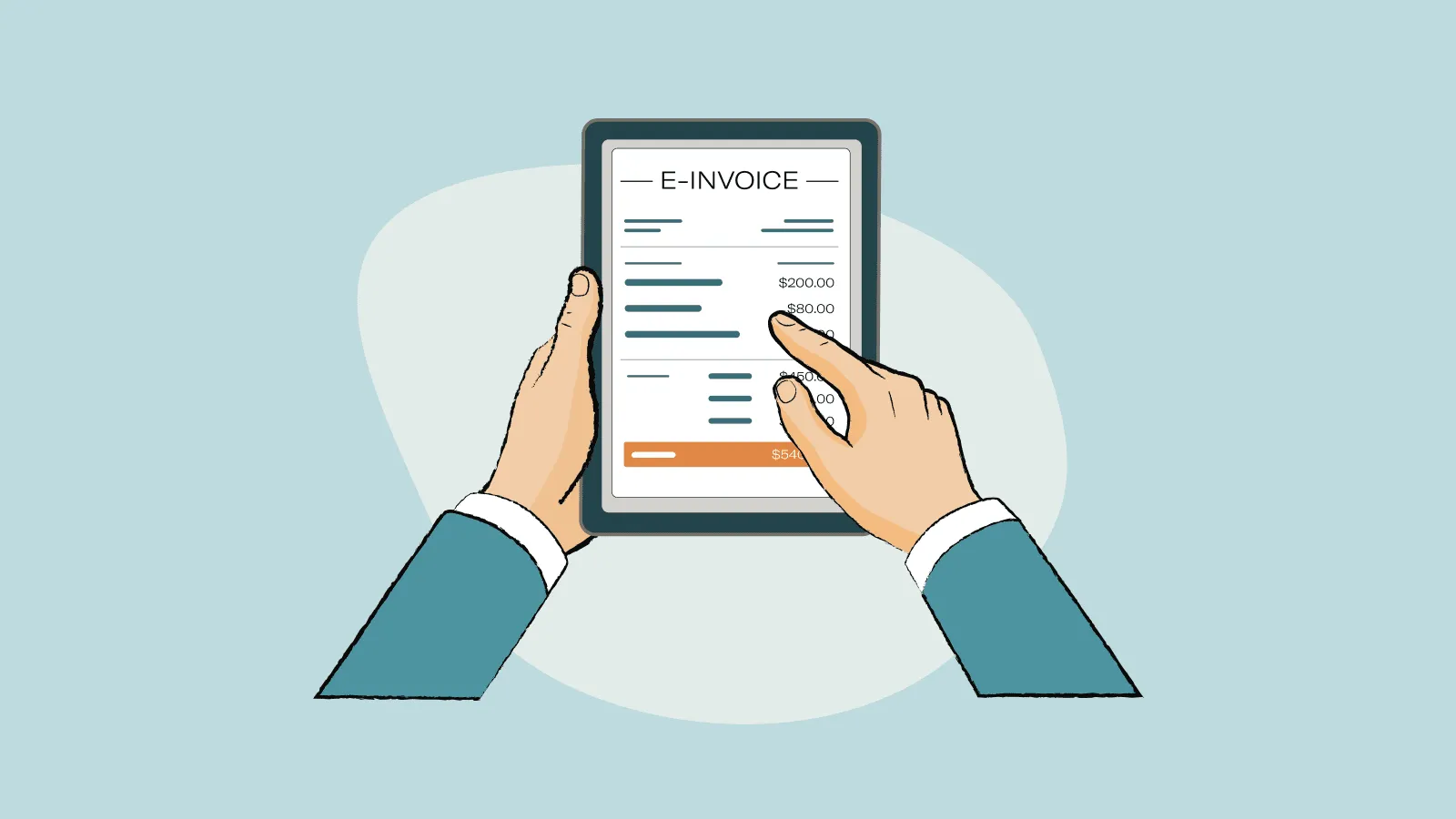
Simply put, an e-invoice is machine-readable data.
E-invoicing regulations and standards vary by jurisdiction, but they all share a common goal: creating structured, machine-readable invoice data that tax authorities can validate automatically.
From the moment a transaction is made, the e-invoice data moves through APIs, government clearance networks, and third-party platforms, enabling tax authorities to instantly cross-reference transactions.
In turn, they’re able to flag discrepancies within hours, and thus close the gap between taxes owed and taxes actually collected, and this is true for governments around the world:
- The European Commission’s VAT in the Digital Age (ViDA) proposal, expected to mandate e-invoicing for cross-border B2B transactions across all member states, is one of the largest upcoming shifts.
- Mexico, Brazil, and Chile already run clearance models where the tax authority must approve an invoice before it’s legally valid.
- India’s GST e-invoicing mandate has expanded steadily since 2020.
- South Korea and Taiwan have operated mature systems for over a decade.
If you’re still getting familiar with how these systems work, this guide to e-invoicing is a good starting point. One essential consideration is the security implications of such requirements.
The security implications here are easy to overlook. A paper invoice sat in a filing cabinet. A PDF lived on a local server with limited access. An e-invoice, by design, passes through multiple systems in seconds. It carries customer names and addresses, tax identification numbers, banking details, transaction values, and in many cases the specific products or services purchased - all hugely impactful data points in a person’s digital footprint.
Aggregate a few thousand of those, and you have a detailed map of your business relationships, your pricing, and your customer base. Each system in the transmission chain is, in practice, a potential point of exposure.
Five common security risks in cross-border electronic invoicing
1. Real-time data transmission leaves no room for manual security checks
Under most e-invoicing regimes, invoices must reach the tax authority in real time or near real time. Your system generates the invoice, and it goes out. There’s no staging queue, no human review step, no buffer window.
While this is the whole point of the system, it’s exactly the problem. A misconfigured API endpoint or a set of compromised credentials can bleed invoice data for hours before anyone on your team even spots the issue.
2. Multiple integration points increase the attack surface
A typical e-invoicing flow looks like this:
- Data moves from your ERP or accounting software to an invoicing platform
- Then into a government network like PEPPOL
- Finally on to the tax authority.
Furthermore, depending on your company's exact setup, there might also be payment processors, tax calculation engines, or archiving services that receive the data. That’s four to six handoff points, each with its own authentication method, its own API configuration, and its own potential for misconfigured permissions.
Most businesses, understandably, concentrate their security investment on the systems they own. The connections between systems tend to get less scrutiny, and those gaps are precisely where interception or manipulation is likeliest to occur.
3. Cross-border data sovereignty and privacy conflicts
A single cross-border invoice can fall under the privacy laws of three jurisdictions at once: the seller’s country, the buyer’s country, and the country where your servers physically sit. The EU’s GDPR restricts how personal data is transferred outside the bloc. India’s data localization rules require certain categories of data to stay on domestic servers. Brazil’s LGPD has its own consent and processing requirements that overlap with, and sometimes contradict, GDPR provisions.
E-invoices carry both personal data (names, addresses, tax IDs) and commercially sensitive information (pricing structures, transaction volumes, customer lists). When your data storage or processing location doesn’t match what a particular jurisdiction requires, you end up exposed on multiple regulatory fronts at the same time. In practice, many businesses discover these conflicts only when they try to expand into a new market and their existing infrastructure doesn’t fit.
4. Long-term storage creates future security risks
Most jurisdictions require you to retain invoices for seven to 10 years, but the exact timelines vary significantly:
- Germany requires 10.
- The UK requires six.
- India’s GST rules call for a minimum of 8 years from the due date of the annual return.
Over that kind of timeframe, the encryption algorithms you’re relying on today will undoubtedly need upgrading.
Access management policies tend to drift as teams change and systems get replaced, for instance an archive that was secure when it was created in 2024 may have real vulnerabilities by 2031 if nobody has reviewed the access controls or re-encrypted the data to current standards.
Quantum computing developments add further uncertainty here, because encryption methods considered unbreakable today could become vulnerable well within a typical invoice retention period.
5. Third-party access without creating backdoors
Your invoice data usually needs to be accessible to people outside your organization.
As we've mentioned, tax authorities need submission and audit access. Your accounting firm needs transaction records. External auditors need read access during reviews.
Each of these access points needs to be scoped tightly. The usual problem is shared credentials that never get rotated, or permissions set too broadly because it was faster at the time.
These create persistent openings that grow riskier the longer they go unreviewed, and the risk compounds as your business adds more partners and jurisdictions.
Six best practices for secure and compliant e-invoicing
Given these risks, here are the six best steps you can practically take to enhance security during compliant e-invoicing.
1. Encrypt everything, everywhere
All API connections should enforce TLS 1.3 at a minimum.
Any stored database needs AES-256 encryption, and thus needs to remain strong enough to hold up across a full ten-year retention window. Any fields containing payment amounts, pricing, or banking details should be encrypted during processing as well, so the data is protected even while it’s in active use.
Jurisdiction-specific requirements add another layer. GDPR calls for “appropriate technical measures” for personal data, which in practice means encryption is expected. Brazil’s NF-e system specifies its own certificate and transmission security standards. India’s GST framework has separate requirements again.
On top of all this, key management matters enormously. Use hardware security modules (HSMs) or a cloud KMS like AWS KMS or Google Cloud KMS. Rotate keys annually at a minimum. Hardcoding keys into application code is surprisingly common and defeats the purpose of encryption entirely.
2. Implement digital signatures and cryptographic seals
A digital signature confirms who sent an invoice and proves the document hasn’t been altered since signing. A cryptographic seal goes further by binding the data to a specific timestamp, which creates tamper-evidence that regulators, particularly in Europe, increasingly require.
Spain’s Verifactu system is a good example. It mandates cryptographic seals on invoicing records so that their integrity can be verified for tax reporting.
In terms of implementation: use certificates from a recognized certificate authority, sign invoices at the point of generation (before they enter the transmission pipeline), and keep signed copies in their original format. If a document gets modified downstream, the broken signature makes it immediately traceable. This is one area where getting the sequencing right matters more than the technology itself.
3. Secure your API integrations
Every API connection in your e-invoicing flow needs its own security setup, the baseline of which is OAuth 2.0.
Next, API keys should be rotated on a defined schedule (quarterly at a minimum for high-volume connections). Rate limiting protects against volumetric attacks so set a rate ceiling that reflects your actual transaction volume which will help spot anomalies quickly.
A centralized API gateway (Kong, AWS API Gateway, or similar) gives you unified logging and security policies across all your integrations, which makes monitoring significantly easier than managing each connection individually. Verify webhook payload signatures before processing anything. Run audits against the OWASP API Security Top 10 at least twice a year. And document every integration’s security configuration somewhere your team can actually find it.
This sounds basic, but in practice, the documentation step is the one that gets skipped most often, and it’s the one that causes the most confusion during incident response.
4. Maintain compliant data retention and deletion
With the EU's VAT in the Digital Age (ViDA) framework mandating cross-border B2B e-invoicing by July 1, 2030, the volume of digital invoice data requiring secure long-term storage will increase significantly.
VAT and GST rules say keep invoice records for seven to 10 years. However, GDPR says delete personal data when you no longer need it. Both apply at the same time. Satisfying both requires a specific kind of data architecture.
Pseudonymization combined with data separation is the most practical solution. Store customer-identifying information (names, addresses, contact details) separately from transaction records, linked only by internal reference IDs. Set up automated policies that archive invoice data after the required period and delete non-invoice personal data on a schedule. Keep immutable deletion logs for audit trails. Store regional data in the right geography: EU-origin data in EU infrastructure, Indian data on Indian servers.
This setup also simplifies things when a customer exercises a GDPR deletion request, because you can remove the identifying information without touching the invoice records that tax law requires you to keep.
5. Prepare for security incidents and audits
The gap between a minor disruption and a serious penalty usually comes down to whether your team has a documented, tested response plan or is improvising under pressure.
Start by first defining exactly what counts as a security event in your context (unauthorized access, data exfiltration, ransomware, API compromise). Write out the procedures: who gets notified first, how containment works, and how evidence is preserved. Ensure your digital support infrastructure can handle the surge of customer inquiries that typically follows a security incident. Then actually test it.
Quarterly breach simulations and backup recovery drills are the standard, though honestly, most teams run them less frequently than they should. For remote teams, conducting webinars regularly on security awareness ensures everyone understands their role during an incident, regardless of location.
Audit readiness is a separate discipline. Keep your data flow diagrams, encryption standards, and access control documentation current. Maintain reports covering access logs, data modifications, and API call histories in a format auditors can work with directly. SOC 2, ISO 27001, and PCI DSS certifications give you a structured framework for all of this and provide evidence of compliance that satisfies auditors, enterprise customers, and partners. The certification process itself usually surfaces gaps you didn’t know you had.
6. Choose the right e-invoicing security tools and partners
Building enterprise-grade invoicing security from scratch requires specialized expertise that most online businesses, realistically, do not have in-house. Your platform choice determines your baseline security posture, how many jurisdictions you can operate in compliantly, and how much of the ongoing compliance workload falls on your team versus the tooling.
Quaderno invoicing handles this layer. It automates tax-compliant invoicing across more than 12,000 jurisdictions, calculates the correct tax at checkout in real time, and generates invoices that meet local e-invoicing requirements. It plugs into the payment processors and e-commerce platforms most online businesses already run on (Stripe, Shopify, WooCommerce, PayPal, among others).
Because Quaderno manages tax registration monitoring, automated filing, and jurisdiction-specific formatting, your team stays focused on growth. The compliance mechanics run in the background.
Taking the next step toward secure global e-invoicing
Every invoice your business generates now moves through a chain of systems, borders, and regulatory frameworks. That chain is getting longer and more complex every year. Protecting the data flowing through it requires encryption at every stage, tightly scoped access, architecture that can satisfy a ten-year tax retention requirement and a GDPR deletion request at the same time, and incident response plans that have actually been rehearsed.
The six practices in this article give you a workable framework. Encryption and digital signatures form the base. API security, compliant retention policies, and audit readiness build on top. Each layer reinforces the others, and the whole structure scales as your regulatory footprint grows. Getting these foundations right now saves you from expensive remediation later, especially as more jurisdictions tighten their enforcement.
Quaderno simplifies the global VAT, GST, and sales tax compliance side of this equation, so you can put your energy into growing the business.
Note: At Quaderno we love providing helpful information and best practices about taxes, but we are not certified tax advisors. For further help, or if you are ever in doubt, please consult a professional tax advisor or the tax authorities.